Journal · Field notes
Cover ups: when an old tattoo can be covered, and how
A cover up is a new tattoo with an old one underneath. The result depends on darkness, size and an honest read of what is already there.
When can a tattoo be covered?
A tattoo can usually be covered when the new design is larger than the old one and carries enough darkness to absorb it. Ink does not erase ink. The new piece hides the old one by placing dark values, dense texture or strong color exactly where the old lines sit.
Three things decide the outcome: how dark the old tattoo is, how big it is and where it sits on the body. A faded name in thin script is a much easier starting point than a solid black tribal band. Clear photos of the area are the first thing to send.
Which styles hide an old tattoo?
Styles that build with darkness and density have the advantage. Traditional uses heavy black outlines and solid fills, so its shapes can be placed to swallow old lines. Neo-Oriental brings waves, wind bars, scales and deep color backgrounds, which give a cover up plenty of places to hide old ink.
Black & Grey can cover well when the design is planned with deep shadows over the old work. Its soft gradients are less forgiving where the old ink needs to disappear, so the dark areas have to be designed in on purpose. Color works through saturation: dense colors set against black hide more than pale tones do.
Light, open designs struggle as cover ups. Fine lines, pastel color and large areas of bare skin let the old tattoo show through. If the idea you have in mind is delicate, it may suit fresh skin somewhere else.
Case files
The cases,
photographed.
Real cases, photographed before and after. The old tattoo is read first: how dark it is, where it sits, what it can hide.
The Lovers, over an old Joker
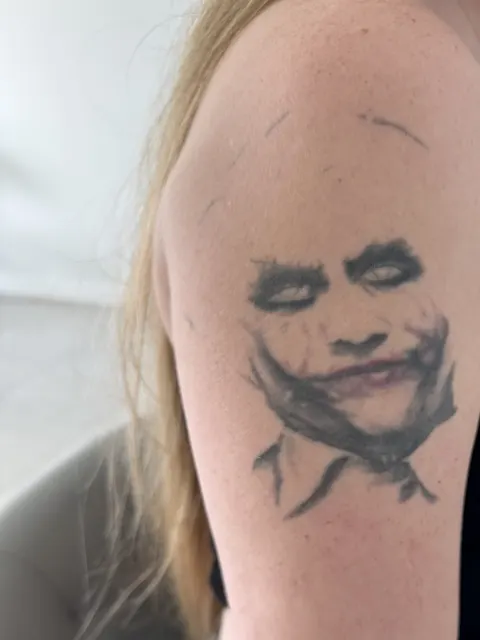
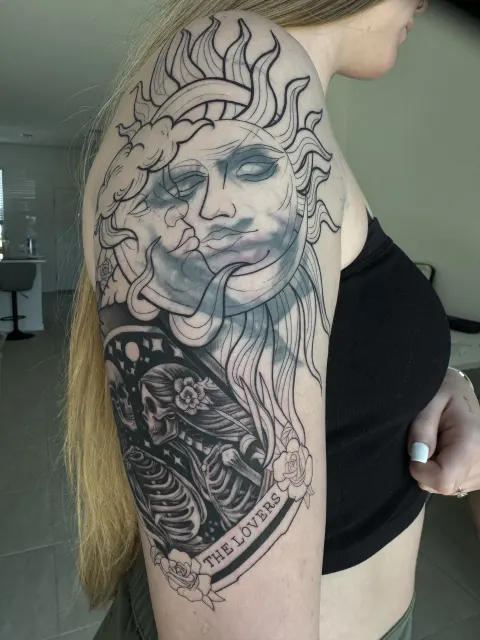
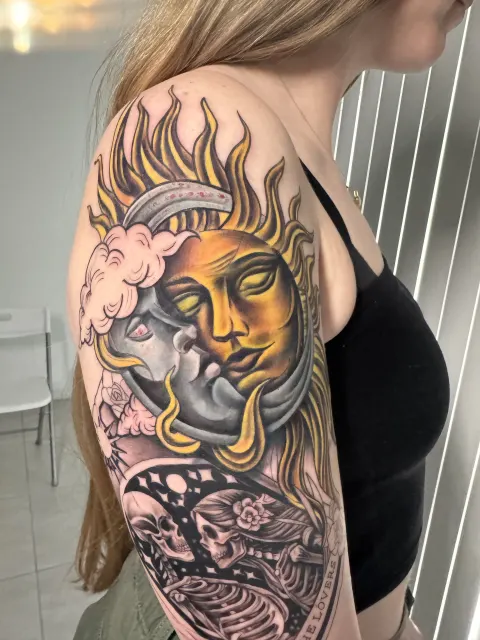
A faded portrait turned into a sun-and-moon half sleeve. The old dark areas were planned into the new shadows; the design was adjusted freehand on the arm before the first line.
Lilies into an owl
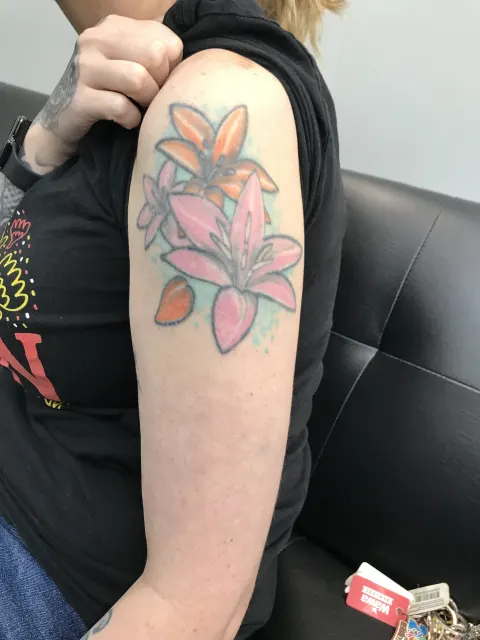
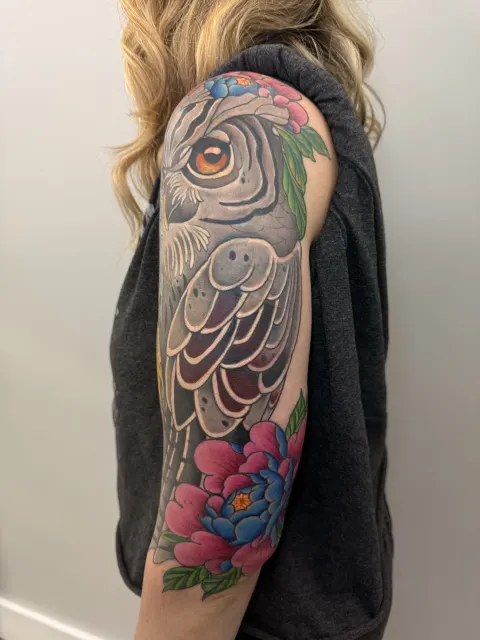
Pale lilies on the shoulder disappear inside the owl's head and a band of peonies. Color and value were chosen to sit on top of the old pinks, not fight them.
A Japanese leg sleeve, brought back
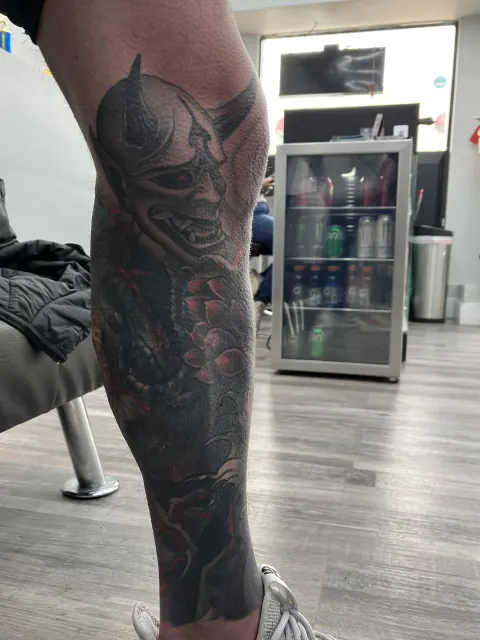
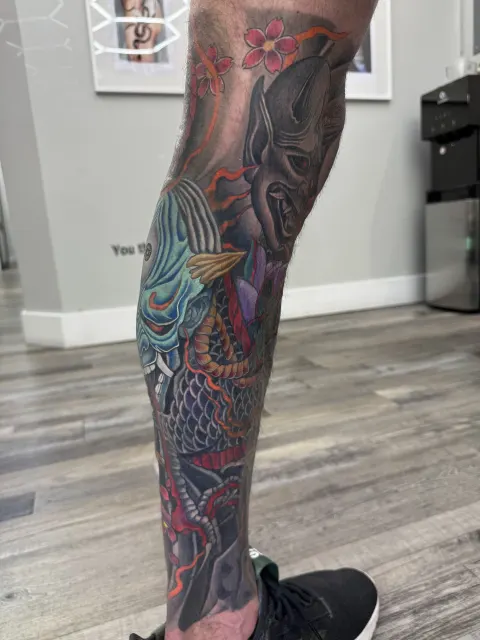
Years had flattened the color and blurred the edges. Lines were reinforced and the palette rebuilt section by section until the hannya and the koi read again from across a room.
The honest limits
Some tattoos cannot be covered as they are. A very dark, very large piece leaves no room for a new design to sit on top, and covering it often means going much bigger and much darker than you wanted. In those cases, lightening the old ink with laser before the cover up is a common recommendation, and that decision belongs to you and a laser specialist.
Placement adds its own limits. Hands, fingers, the neck and areas already crowded with other work give the design little space to grow. A sound cover up plan says this up front, before any deposit is paid.
Expect the new piece to be bigger than the old one, and expect the old design to guide some of the choices. A cover up rarely lets you pick any image at any size. The quote is where those trade-offs are laid out clearly.
How a cover up is planned
Planning starts with photos of the old tattoo and a conversation about what you want to wear instead. Dymon draws the new design on an iPad, placing the darkest parts of the composition over the darkest parts of the old work. The stencil comes next.
Then comes the step that makes a cover up work on a real body. Dymon works freehand with a marker directly on the skin, adjusting the stencil to the anatomy and to the old lines underneath. He did this on a shoulder cover up that had to connect with an existing full sleeve, shaping the new piece until both read as one.
Large cover ups can take more than one session. The quote defines how many and how long each one runs, along with the size, placement and level of detail.
When to restore instead of cover
Some old tattoos only need their lines and color back. If you still like the design and it has simply gone dull, a retouch or a restoration may be the right path. That choice keeps the piece you already chose once.
Dymon retouches and restores older tattoos by reinforcing the linework and refreshing the saturation. One client review describes old tattoos that looked dull coming back to life after his work. A restored piece keeps its story, and it costs you less skin than a cover up.
Booking a cover up consultation
Send clear photos of the old tattoo in natural light, along with its approximate size and your idea for the new piece. Quotes happen by WhatsApp or phone, in English or Spanish, with Dymon or with Milena, who coordinates his schedule. Each cover up is quoted on its size, placement, level of detail and number of sessions.
Once the plan is agreed, a $100 deposit paid on the site through Square holds your date and is deducted from the total. The deposit is non-refundable, and appointments cannot be rescheduled or cancelled. His base is New Jersey, with seasonal dates in Orlando, Charlotte and Dallas as a guest artist.