Journal · Field notes
Neo-Oriental vs Japanese tattooing: what changes, what stays
Both traditions draw the same koi, hannya masks and dragons. The difference lives in how the image is rendered, colored and fitted to the body.
What is the difference between Neo-Oriental and Japanese tattooing?
Traditional Japanese tattooing, often called irezumi, is a closed system with centuries of convention behind it. Its imagery, its backgrounds and its rules about what belongs together are passed down from master to apprentice. Neo-Oriental starts from that same vocabulary and redraws it with contemporary color and flow.
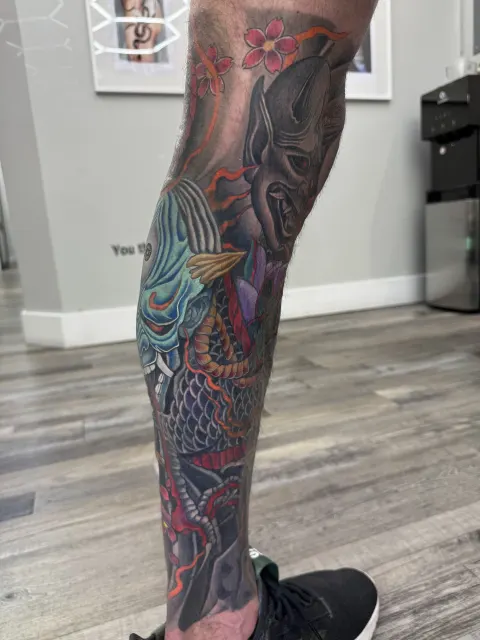
The subject rarely changes between the two. A koi is still a koi, and a hannya mask still carries the story it carried on the Noh stage. What changes is the execution: contrast, color depth, the edge of each shape and the freedom of the composition.
What stays: the imagery and its meaning
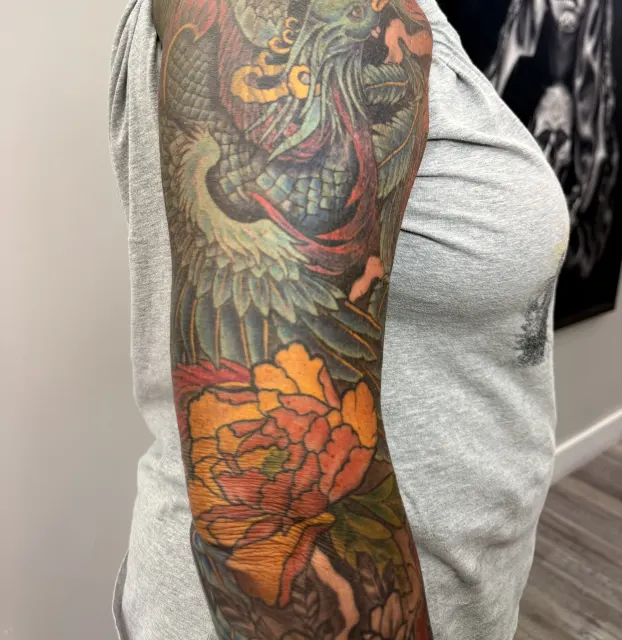
Neo-Oriental keeps the core cast of Japanese tattooing. Koi, dragons, tigers, serpents, hannya masks, peonies, cherry blossoms, waves and wind bars all come straight from that tradition. Each one arrives with its meaning intact.
The koi that climbs the waterfall still speaks of perseverance and transformation, since legend says it becomes a dragon at the top. The hannya still stands for jealousy and resentment turned into something fierce, and many people wear it as a guardian. A piece that ignores those meanings loses its weight, so the research happens before the drawing.
Scale stays too. Both traditions think in large formats: backs, full sleeves, legs and chest panels planned as one continuous current. A small koi on a wrist can look good, but the language shows its full strength when it has room to move.
What changes: the rendering
Classic Japanese work leans on heavy black outlines, a restrained palette and backgrounds shaded in dark, even gradients. Its imagery grew out of ukiyo-e woodblock prints, and some masters still work by hand, a method called tebori. That restraint is part of its beauty and part of why it ages so well.
Neo-Oriental pushes the contrast. Colors run deeper and brighter, transitions get smoother, and the edge of each scale, petal or flame is drawn cleaner. The goal is a piece that reads clearly on modern skin and under modern light, from across a room and up close.
Backgrounds change as well. In traditional work, wind bars, water and clouds follow established patterns that frame the main figure. In Neo-Oriental those elements stay, but they bend more freely around the anatomy and can carry more color.
Composition: convention and flow
Traditional Japanese composition follows rules. Certain flowers belong to certain seasons, certain animals pair with certain backgrounds, and a full bodysuit is planned as a single framed image. Those conventions give the work its discipline, and purists expect them to be respected.
Neo-Oriental keeps the logic of the large composition and loosens the rulebook. Dymon draws the design on an iPad, transfers the stencil, then works freehand with a marker directly on the skin. That last step bends the waves, the tail of the dragon or the body of the koi to the real shape of the shoulder, the calf or the ribs.
The result moves with the muscle instead of sitting on top of it. On a full sleeve or a back piece, the difference shows the moment the arm turns or the shoulder lifts.
Which one suits your piece?
Choose traditional Japanese if you want the convention itself: the classic palette, the strict pairings, the look handed down for generations. It is also the natural path if you are planning a full bodysuit with an artist trained inside that lineage. In that case, respect for the rules is the whole point.
Choose Neo-Oriental if you love the imagery but want stronger contrast, deeper color and a composition shaped closely to your anatomy. It also suits clients who already wear other styles and want the new piece to sit next to Color or Black & Grey work without clashing. The meanings stay, and the rendering speaks the same visual language as the rest of your skin.
Size matters in both directions. If the space is small, a single strong figure, such as a koi, a hannya or a peony, reads better than a crowded scene. If you have a full sleeve, a back or a leg available, both languages reward a plan that covers the whole area from the start, even when the work is done over several sessions.
How Dymon approaches a Neo-Oriental piece
Dymon Jimenez has been tattooing for more than 25 years, and the Oriental category carried a large part of his early record. Between 2015 and 2017 he placed in Oriental categories at conventions in Colombia and Ecuador, before bringing his work to the United States. Neo-Oriental is one of the five languages he works in today, alongside Traditional, Color, Black & Grey and Anime.
His base is New Jersey, and he also opens dates by season in Orlando, Charlotte and Dallas as a guest artist. Every piece starts with a quote by WhatsApp or phone, in English or Spanish, where size, placement and the number of sessions are discussed. From there, the design is drawn for your body alone.