Journal · Field notes
What a jury rewards in Best Traditional
Convention judges look at a Traditional piece the way the style was meant to be seen: from across the room first, then up close. Five criteria decide the podium.
What do judges look for in a Best Traditional category?
Each convention sets its own rules, but Traditional categories tend to be judged on the same fundamentals. The style rests on rules that have held for about a century, so a jury can measure a piece against them with real precision. Five points come up again and again: readability at a distance, line, solid fills, composition and healing.
Dymon Jimenez has been tested on those points in front of juries in the Northeast and in Florida. Between 2022 and 2026 he placed in Best Traditional and American Traditional categories at five events, from New York to Orlando. Each result below is tied to its event, category and year.
Readability at a distance
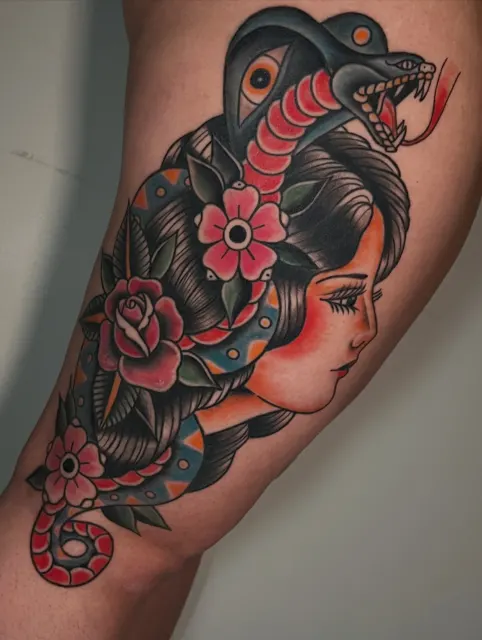
A Traditional tattoo should read from across the room. The judge sees the silhouette first: a panther, a rose, a dagger, a woman's face. If the image needs a close look to make sense, it has already lost points.
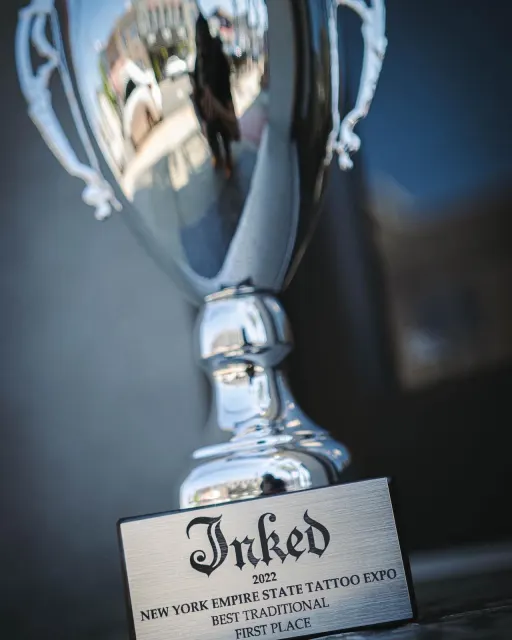
That test explains the style's limited palette and its bold shapes. Every element has a clear outline and a clear job, and nothing competes for attention without a reason. In 2022, a Traditional piece by Dymon took 1st Place, Best Traditional, at the NY Empire State Tattoo Expo.
Line: weight, consistency and clean passes
Line is where judges get close. They look for outlines that hold one weight from start to finish, curves without wobble and joins without visible overlaps. A heavy line pulled in one confident pass is the signature of the style.
Line also carries the piece into the future. Bold outlines keep their shape as ink settles and softens over the years, which is why Traditional ages with dignity. At the Meadowlands Villain Arts Tattoo Festival 2024, two of Dymon's pieces placed in the same category: 1st and 3rd Place, Best Traditional.
Solid fills: black and color with no holes
Solids leave nowhere to hide. A black fill should look like one even field, with no gaps, no streaks and no patches where skin shows through. The same applies to color: saturated, even and packed edge to edge.
Judges check solids under good light, because unevenness shows as soon as the skin moves. At the 3rd Hudson Valley Tattoo Convention 2025, Dymon took 1st and 2nd Place, American Traditional, again with two pieces on the same podium.
Composition: how the piece sits on the body
A Traditional design can be strong on paper and still fail on the body. Judges look at how the image fits the placement: whether it follows the arm or the leg, how it uses the space and whether the negative space breathes. Crowded compositions lose readability, and crooked ones fight the anatomy.
This is where freehand work matters. Dymon draws the design on an iPad, transfers the stencil and then adjusts it with a marker directly on the skin so the piece sits with the muscle. In 2026 he took 1st Place, Best Traditional, at the Meadowlands Tattoo Arts Festival, in New Jersey, the state where he is based.
Healing: the test that comes later
Many entries are judged soon after they are made, with the redness and shine of a new tattoo. A healed category removes that advantage and shows the work as it will live on the skin. Line weight, solid fills and contrast either held, or they did not.
At the Orlando Tattoo Show 2025, Dymon took 2nd Place, American Traditional, Healed. For a client, a healed result answers the question that matters after the convention lights go off: how the tattoo will look years from now.
A record that started in Latin America
Dymon learned the craft empirically more than 25 years ago, after trading his skateboard for a tattoo machine. Before his results in the United States, he competed and won in Colombia, Ecuador and Mexico between 2014 and 2017. In 2019, the City Council of Ibagué, his home city, honored him with Resolution 198.
Today he works in five languages: Traditional, Neo-Oriental, Color, Black & Grey and Anime. Every piece is quoted by WhatsApp or phone, in English or Spanish, according to its size, placement, level of detail and number of sessions.